Vuong Doanh
Go Beyond Yourself. Pursue Excellence
Go Beyond Yourself. Pursue Excellence
Design & Production Serivce
036 6169 888





First of all, never complicate the handling of non‑conforming products. When defective products occur during production, the traditional approach is for operators to rework or scrap the non‑conforming items. However, such treatment addresses the symptoms rather than the root cause, and similar problems tend to recur repeatedly. Carton plants with higher management standards, when encountering non‑conforming products, will investigate the causes and analyze the consequences. The common practice is: under the principle of minimizing waste, non‑conforming products that can be repaired to meet quality standards are subject to remedial measures. Products that cannot be salvaged are generally sold as waste paper. In our interviews, some carton factories handle unsalvageable defective products in a very humane way: they shred cartons bearing important client logos before selling them as waste paper, so as to prevent criminals from using the packaging for counterfeiting. This practice not only protects the clients' interests but also earns their trust. Additionally, some factories set up dedicated display areas for non‑conforming products, assign on‑site operators to analyze each defective item one by one, identify the root causes, propose corresponding corrective measures, and at the same time keep records and establish a comprehensive non‑conformance log. Production practice shows that such measures serve as an effective warning and also create an incentive mechanism among on‑site operators, significantly reducing the product defect rate.
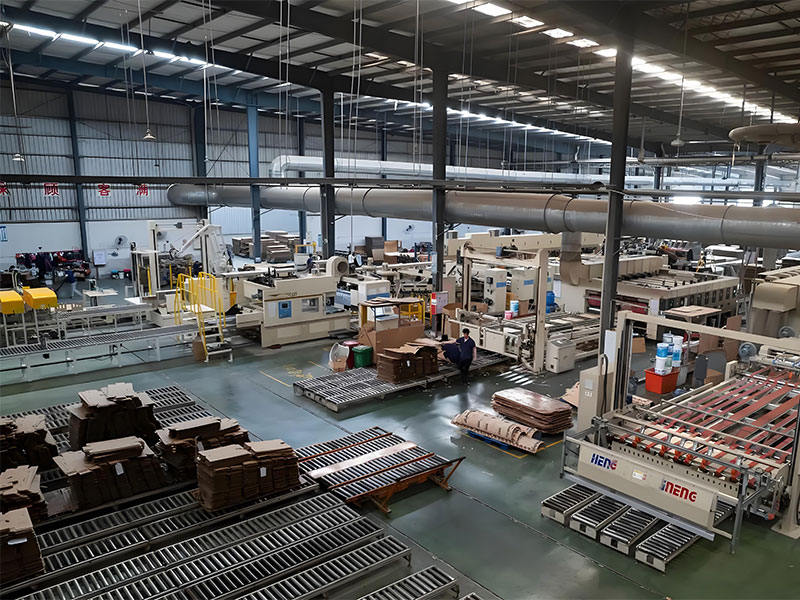
Secondly, Vuong Doanh Company Limited requires emergency handling of abnormal conditions as soon as they are detected during production, effectively "nipping defective products in the bud." During the carton production process, once workers spot any abnormality, they are required to promptly report it to their supervisors and take immediate corrective actions. For example, if necessary, an emergency machine stop may be executed, all available technical personnel on site are mobilized to quickly resolve the issue, and practical countermeasures are formulated to prevent recurrence. The purpose of emergency handling is not only to ensure that no defective product escapes the production floor, but also to eliminate quality hazards throughout the production process.
It is widely recognized in the manufacturing industry that setting inspection as an independent position does not add any added value, and detecting defects after the fact is not the most effective way to reduce waste. However, if 100% full inspection is regarded as an integral process step, it is no longer waste but a necessary condition to ensure products meet specified requirements. Therefore, as part of process control, operators must be required to carry out full inspection. Accordingly, the duty of quality inspectors is not merely to detect and remove non‑conforming products, but to thoroughly eliminate them. The practice widely adopted in carton factories today—where downstream processes monitor upstream processes—is precisely aimed at this goal. By clearly defining responsibilities and establishing reward and penalty systems, operators are encouraged to conduct self‑inspection, detect defects, and prevent non‑conforming products from flowing into subsequent processes.